
Tires & Detailing · Free tool
Free Tire Pressure Calculator
Enter the pressure you set and the temperature then and now. The calculator shows what the tires hold today, how much air to add and the same figure in bar and kPa.
- Free to use
- No signup
- Runs in your browser
Temperature change
From the placard on the driver’s door jamb, not the tire sidewall.
Unit converter
Expected pressure now
31.2 PSI
Down 3.8 PSI from a 40°F drop.
Add about 3.8 PSI to get back to the recommended 35 PSI.
- Expected pressure in bar
- 2.15
- Expected pressure in kPa
- 215
- Change per 10°F here
- 0.94 PSI
Converted
- PSI
- 35.0
- Bar
- 2.41
- kPa
- 241
A calculation is not a reading. Check the tires with a gauge when they are cold.
An estimate from the figures you enter, not a quote. Read the disclaimer. Updated .
02Your result
What your tire pressure result means
Air contracts as it cools. A tire that was right in September can be several PSI low in January without having lost any air.
- 01
Expected pressure now
What the tire should hold at today’s temperature if it has not leaked. It is a prediction, so confirm it with a gauge.
- 02
Air to add
The gap between that figure and the recommended cold pressure for your vehicle.
- 03
PSI, bar and kPa
The same pressure in the three units you will meet on gauges, door placards and air machines.
What to do next
Learn what the TPMS light means
The dashboard warning lights and which of them mean stop.
Warning lightsCheck the tires themselves
Tread depth, rotation and the age at which a tire should be replaced.
Tire guideCompare tire sizes
Thinking of a different size? See what it does to diameter and speedometer.
Tire size calculator
03How it works
The tire pressure and temperature formula
For a fixed amount of air in a fixed space, pressure rises and falls in step with absolute temperature. That is Gay-Lussac’s law.
P2 = (P1 + 14.7) × (T2 + 459.67) ÷ (T1 + 459.67) − 14.7
Adding 14.7 turns a gauge reading into absolute pressure. Adding 459.67 turns °F into an absolute temperature.
kPa = PSI × 6.895. bar = PSI × 0.0689
The rule of thumb from tire makers: about 1 PSI for every 10°F.
What each term means
- P1
- The pressure you set, read on a gauge, in PSI.
- T1
- The air temperature when you set it, in °F.
- T2
- The air temperature now, in °F.
- P2
- The pressure the tire should hold now, in PSI.
What the tool assumes
- The tire has not lost any air since you set it.
- The tire is cold: it has matched the outside temperature and has not just been driven.
- Sea-level atmospheric pressure of 14.7 PSI.
- The tire’s volume does not change, which is close to true for a car tire.
04Worked example
Tire pressure example: a 40°F drop
Tires set to 35 PSI on a 70°F afternoon, checked again on a 30°F morning.
- 01
Convert the pressure to absolute
35 PSI + 14.7
49.7 PSI
- 02
Convert both temperatures
70°F and 30°F, each + 459.67
529.67 and 489.67
- 03
Scale the pressure
49.7 × 489.67 ÷ 529.67
45.9 PSI
- 04
Convert back to a gauge reading
45.9 − 14.7
31.2 PSI
- 05
Find the shortfall
35 − 31.2
3.8 PSI
Pressure at 30°F
31.2 PSI
That is 3.8 PSI low, close to the rule of thumb of 1 PSI per 10°F, and equal to 2.15 bar or 215 kPa.
Try your own numbers05Background
Why tire pressure changes with temperature
The air in a tire is a gas in a nearly fixed space, so its pressure follows its temperature. Michelin puts it simply: each 10°F drop in temperature equates to a loss of 1 PSI. Continental gives the same figure. The formula above reaches almost the same answer from physics.
NHTSA’s guidance on checking pressure is short and worth following exactly.
- Check all tires, including the spare, at least once a month.
- Check them cold, before driving or after the car has stood for a few hours.
- Use the pressure on the Tire and Loading Information label on the driver’s door edge, or in the owner’s manual.
- Do not use the number on the tire sidewall. That is the maximum the tire can hold, not the pressure your vehicle needs.
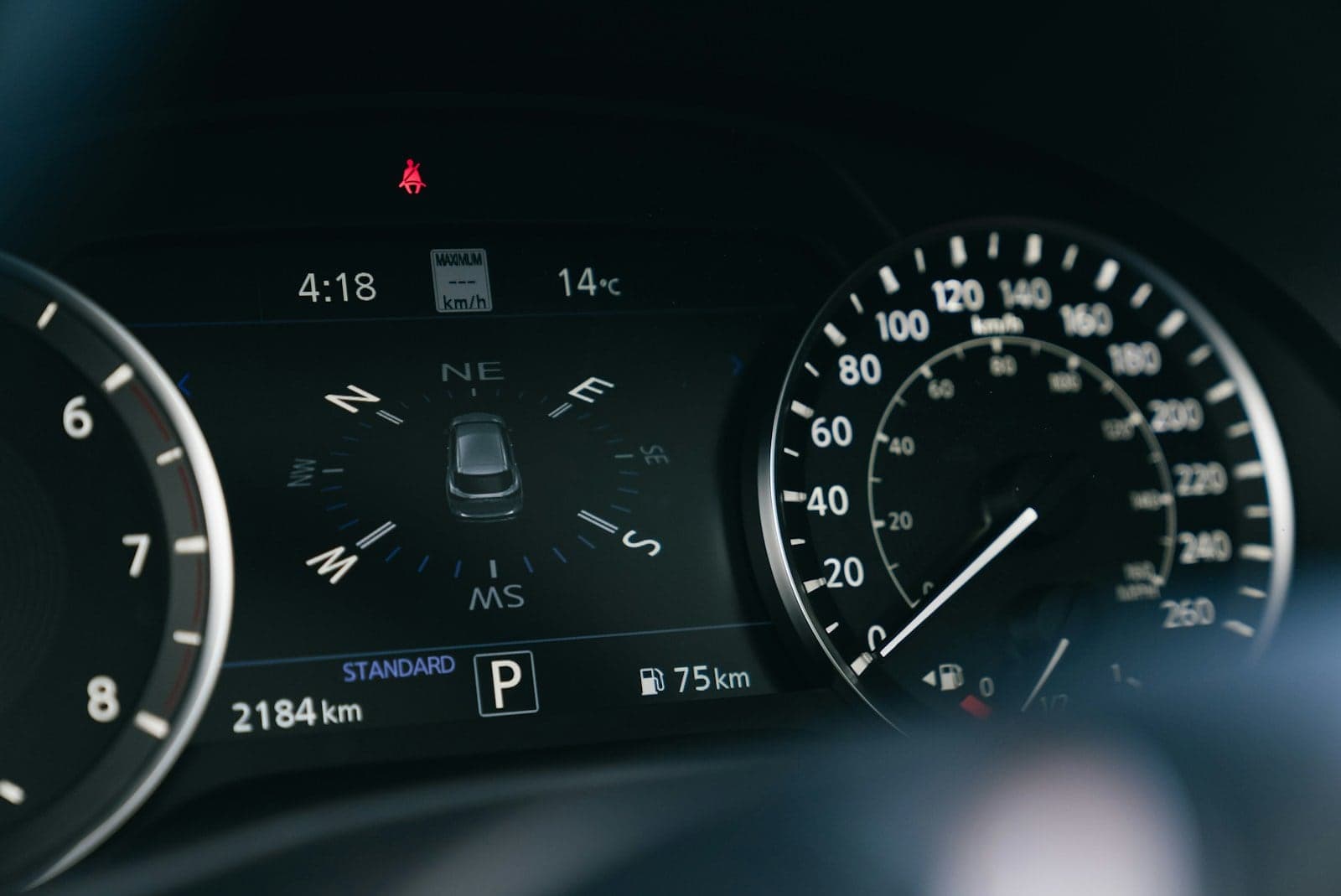
Do not wait for the dashboard light. Federal rules require the tire pressure monitoring system to warn you when a tire is 25 percent or more below the recommended pressure. On a car with a 35 PSI placard that is 26.3 PSI, so a tire can be 8 PSI low with the light still off. See what the TPMS light means.
06When to use it
When to use a tire pressure calculator
Whenever the weather turns, and whenever a gauge or a manual uses a unit you do not.
At the first cold snap
See how far the pressure has fallen before the warning light tells you.
Before a hot-weather trip
Understand why a cold-set pressure reads higher after a long drive.
To convert units
Turn a placard in kPa or bar into the PSI on your gauge.
When the TPMS light comes on
Work out whether a temperature drop explains it or a tire is leaking.
Mistakes to avoid.
- Inflating to the maximum pressure printed on the tire sidewall.
- Checking pressure straight after a drive, when the tires are warm and read high.
- Letting air out of warm tires to bring them down to the placard figure.
- Blaming the weather for a tire that keeps losing pressure. A steady loss is a leak.
07Related guides and tools
Keep going from here.
Guides that go with this tool
Related tools
08Questions
Tire Pressure Calculator: your questions.
How much does tire pressure change with temperature?
About 1 PSI for every 10°F, according to Michelin and Continental. Pressure falls as the air gets colder and rises as it warms.
What PSI should my tires be?
Use the pressure on the Tire and Loading Information label on the driver’s door edge, or in the owner’s manual. The number on the tire sidewall is the maximum the tire can hold, not the recommended pressure.
Why is my tire pressure light on when it is cold?
Cold air lowers the pressure in every tire. The warning system is required to light when a tire is 25 percent or more below the recommended pressure, and a sharp temperature drop can push a tire that was already a little low past that point.
How do I convert PSI to bar or kPa?
Multiply PSI by 0.0689 to get bar and by 6.895 to get kPa. 35 PSI is 2.41 bar or 241 kPa.
Should I check tire pressure hot or cold?
Cold. NHTSA advises checking tires at least once a month when they are cold, because driving warms the air inside and raises the reading.
09Estimates and sources
Read this before you rely on it.
Built and checked by CarTipsMentor Team. Last updated . How we check our work.
Sources
- [1]National Highway Traffic Safety Administration, Tires (TireWise)
- [2]Michelin, Michelin FAQs: tire pressure and temperature
- [3]Continental Tire, TPMS Warning Light: What It Means and What to Do
- [4]Code of Federal Regulations, 49 CFR 571.138: Tire pressure monitoring systems